DEMOCRATIC
You have two cows.
Your neighbor has none.
You feel guilty for being successful.
Barbra Streisand sings for you.
REPUBLICAN
You have two cows.
Your neighbor has none.
So?

 The water buffalo hates the tiger with an endless hate,
 "Books to the ceiling, books to the sky.

 [Man and younger woman in passionate embrace]
 Dr. Kelso: "Son, are you an idiot?"

Be Thankful
Be thankful that you don’t already have everything you desire,
If you did, what would there be to look forward to?Be thankful when you don’t know something
For it gives you the opportunity to learn.Be thankful for the difficult times.
During those times you grow.Be thankful for your limitations
Because they give you opportunities for improvement.Be thankful for each new challenge
Because it will build your strength and character.Be thankful for your mistakes
They will teach you valuable lessons.Be thankful when you’re tired and weary
Because it means you’ve made a difference.It is easy to be thankful for the good things.
A life of rich fulfillment comes to those who are
also thankful for the setbacks.GRATITUDE can turn a negative into a positive.
Find a way to be thankful for your troubles
and they can become your blessings.
~ Author Unknown ~
 The trouble with the world is that the stupid are cocksure and the intelligent are full of doubt.
 Some people are like slinkies...


"There are only a few enlightened people with a lucid mind and style and with good taste within a century. What has been preserved of their work belongs among the most precious possessions of mankind.
"Nothing is more needed than to overcome the modernist’s snobbishness."
- Albert Einstein
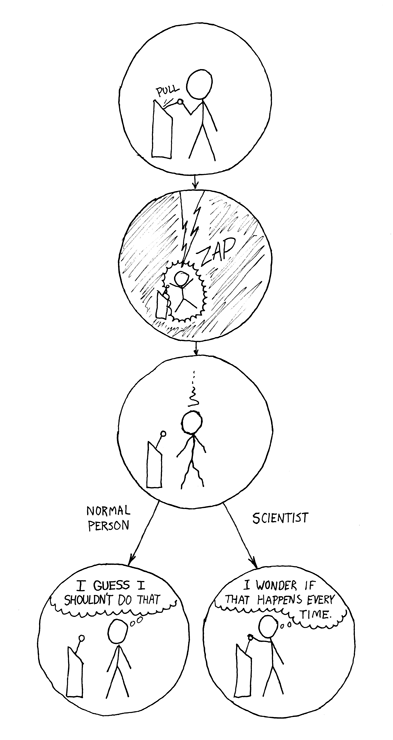

This concept taken from a speech I recently saw on CSpan, given by Ed Brayton:
"In my speech at YearlyKos I'm going to address the problem of virulent ignorance, which is distinguishable from the sort of mundane ignorance that we all have about a great many subjects. Mundane ignorance is a mere lack of knowledge; we are all ignorant of far more subjects than we are knowledgeable of. Ask me about how to fix a car or about the history of choral music in Eastern Europe and I'm as clueless as can be.
"But because I know that I'm ignorant about those subjects, if someone were to ask my opinions about them I would say, "I'm the wrong person to ask, I don't know anything about it." Ask me whether one European soccer team plays better defense than another and I'm not even going to attempt an answer; I simply don't know anything about it and wouldn't be able to distinguish good defense from bad defense even if I spent the next 72 hours watching soccer games. That's mundane ignorance.
"Virulent ignorance, on the other hand, is when someone thinks they know something about a subject when they don't. Virulent ignorance is when someone has absorbed a set of platitudes or claims that they presume to be true without any real ability to evaluate whether they are or not. This type of ignorance is the brass ring of politics, the thing that all political movements strive to inculcate in as many people as possible.
"A politician or a political movement is most successful when they are able to replace the mundane ignorance of a large group of people with a set of pre-formed conclusions that they can offer as opinions without bothering to go through any rational process to reach those conclusions. This gives their followers a set of responses that they presume to be true and gives them the illusion of knowledge. It's what makes people offer opinions to poll takers on subjects that they know virtually nothing about.
 Question:


http://www.anthonyhempell.com/papers/tetrad/concept.html
Macluhan's idea is that every artifact (or technology) goes though four phases, or produces four effects:
Money is a typical example used to explain the tetrad concept. It enhances speed of transaction, obsolesces barter, brings back excessive consumption, and pushed to its limits becomes electronic transfer and credit, or non-money.
Or at least that's how this example is typically given. I'm not sure excessive consumption has ever been obsolete in human history, so I'm not sure how it could have been brought back. And in general I find the third dynamic of the tetrad, bringing back something that was obsolete, to be the most difficult to apply.
But if you want a picture of what lies ahead for any technology, the tetrad concept is a good place to start.


This is a really summarized version, but here it is, PowerPoint-style:
So, basically, you make your stuff into real, actionable items or things you can just get rid of. Everything you keep has a clear reason for being in your life at any given moment—both now and well into the future. This gives you an amazing kind of confidence that a) nothing gets lost and b) you always understand what’s on or off your plate.

Questions to ask yourself when you finish reading a book:
If you answered “yes” to the relevant questions above, keep the book. Otherwise, get rid of it by either passing it along to a friend or family member, selling it to a used book store, or donating it to a charity or a local school or public library.
From unclutterer.com


 Pesticide means any substance or mixture of substances intended for preventing, destroying, repelling, or mitigating any pest [40 CFR 152.3].
 "Well...actually....I AM a rocket scientist"
 You can only get so much work out of one good mule.